
A Spiralled Reckoning
How the camp spectacle of Fanny Craddock’s Christmas kitchen inspired a lifelong affection for the theatrical charm of the Swiss Roll.

During my adolescent years, there were few culinary figures I regarded with quite as much curiosity as Fanny Craddock.
She was not my heroine, at least not in the straightforward sense that a young and impressionable cook adopts heroes.
She was not the person whose recipes I rushed to recreate with devotional zeal, nor was she a chef whose food I felt instinctively drawn toward in the manner I did with Nigella Lawson, Lorraine Pascale, or Delia Smith, each of whom offered me the kind of culinary reassurance that adolescent cooks crave with dishes that felt generous, modern, and faintly glamorous without being forbiddingly technical.
Yet Fanny, in all her theatrical singularity, possessed something that the others did not. She possessed a manner. She possessed a presence. And above all, she possessed style.
Not a style I would ever have chosen for myself, it must be said. I have never once felt the urge to swan through a kitchen in a sequinned evening gown while declaiming instructions in a voice that suggested the presence of both a duchess and a schoolmistress. Nevertheless, it was style of a sort that demanded attention.
Wonderfully camp, unabashedly showy, and executed with the confidence of someone who understood perfectly well that the kitchen, when presented to an audience, is nothing less than a stage. Watching her was never merely a lesson in cookery. It was theatre. She was not simply preparing food; she was performing it.
My first real encounter with this extraordinary spectacle came when I stumbled upon her Christmas programme from the 1970s, an offering that has since acquired something of a cult reputation among devotees of British food television. It was a programme that appeared, at least judging from the unholy number of times she mentioned it, to exist in intimate partnership with a booklet she was extremely keen for viewers to purchase.
One could hardly resent her entrepreneurial spirit. If anything, it added to the sense that one was witnessing an event rather than a demonstration. The entire production carried the faintly operatic air of a festive variety show in which poultry, cream, and glacé fruit were the principal cast members.
What fascinated me was not so much the recipes themselves. Indeed, many of them possessed a distinctly alarming quality when viewed through the lens of contemporary taste. The now notorious mincemeat omelette, for instance, remains one of those dishes that induces a reflexive shudder at the mere thought of it. Even at the age when I first encountered it, when my culinary standards were considerably more forgiving than they are today, the idea struck me as something that ought perhaps to remain confined to the experimental fringes of the festive table.
Yet within that extraordinary programme, there existed a brief, almost throwaway moment that has remained with me ever since. It was the moment when Fanny rolled a roulade.
Now it must be acknowledged that the roulade in question was itself not entirely reassuring. If memory serves, it was a mincemeat roulade, which suggests that in 1975 the British imagination considered that medley of dried fruit and spices to be the only flavour appropriate for the month of December. Nevertheless, the act of rolling it was what held my attention, because what Fanny demonstrated in that moment was not merely technique but composure.

There was no hesitation. There was no visible anxiety. There was none of the tentative prodding that so often accompanies a baker’s first encounter with rolled sponge. Instead, she simply lifted the edge of the cake, folded it over with a movement that was both brisk and fluid, and in what could not have been more than five seconds, the entire thing had transformed itself into a perfect spiral. The roulade lay there, serene and immaculate, as though it had always intended to be rolled.
The remarkable thing was not simply the efficiency of the gesture. It was the ease.
Watching it, I remember thinking that she appeared utterly unworried by the possibility of failure. There was no suggestion that the sponge might crack. There was no apprehension that the filling might escape from the sides and transform the whole endeavour into an embarrassing collapse. The roulade behaved because she expected it to behave.
Only later did I realise that what I had witnessed possessed a name: sprezzatura.
The term, borrowed from Italian Renaissance aesthetics and popularised by Baldassare Castiglione in The Book of the Courtier, refers to a studied nonchalance. A cultivated ease that disguises the labour and discipline required to achieve it. True mastery, the theory goes, does not present itself as effort. It presents itself as inevitable.
And that was precisely what Fanny had achieved. Years of experience undoubtedly lay behind that moment, yet what she projected to the viewer was not the weight of practice but the lightness of confidence. For a young baker, this mattered enormously.
At that point in my life, I was only just beginning to explore the possibilities of baking, and although I had already discovered that cakes possessed a certain magic, the roulade seemed to belong to a more intimidating category of dessert. It was one thing to pour batter into a tin and hope for the best. It was quite another to bake a fragile sheet of sponge and then roll it while still warm without destroying the entire structure.
The prospect filled me with dread. I was convinced that I would be too cautious, too slow, too frightened of the moment when the sponge might crack like thin ice beneath a skater’s foot. I have long suspected that food can sense fear during such moments. Anxiety translates into hesitation, and hesitation is precisely what a roulade cannot tolerate.
Yet Fanny, quite unintentionally, offered me a form of reassurance. Watching her, I began to suspect that perhaps the roulade was not a monstrous culinary trial after all; perhaps it was simply a matter of nerve.
So I tried it. Then I tried it again. And again.

The first attempts were not, it must be admitted, masterpieces. Some cracked. Some leaned at awkward angles that suggested structural uncertainty. One or two resembled geological strata more than they did pastry spirals. Yet the essential revelation had already occurred: the thing was possible.
Gradually, the motion became familiar. One learned to roll swiftly yet gently, to coax the sponge into its spiral while it was still warm enough to cooperate. Eventually, the gesture began to feel almost natural. The roulade, once a source of dread, became something I actively looked forward to making.
In time, I realised that I had also absorbed something of Fanny’s theatrical instinct. The roulade is, after all, an inherently performative cake. Its appeal lies not merely in its flavour but in its form. When sliced, it reveals a spiral that feels faintly architectural, a small edible monument to geometry and patience.
There is something undeniably camp about it as well.
The Swiss roll - because that is the name by which it most commonly travels in Britain - carries with it a whiff of nostalgia that is difficult to resist. It is the sort of cake that appears at the edges of childhood memory. It is a treat offered by one’s mother after school, perhaps, or a brightly wrapped specimen retrieved from a bakery window on a Saturday afternoon.
Unlike the sober respectability of a fruit cake or the simple domesticity of a Victoria sponge, the roulade feels faintly mischievous. It is a cake that has chosen to behave differently.
Its history, intriguingly, is every bit as theatrical as its appearance.
Despite its name, the Swiss roll is not Swiss at all. The term “roulade” itself derives from the French verb rouler, meaning “to roll”, and the technique seems to have emerged from the broader transformation of European baking during the late eighteenth and early nineteenth centuries. The crucial innovation was the development of lighter sponge cakes, most notably the génoise, whose structure relied almost entirely upon whipped eggs rather than heavy quantities of butter.
Such sponges possessed a flexibility that earlier cakes lacked. When baked in thin sheets, they could be rolled without crumbling, provided the baker acted quickly enough.
French pastry books from the 1820s and 1830s already describe gâteau roulé: thin layers of sponge spread with jam or cream before being rolled into tight spirals. The technique spread rapidly across Europe, acquiring local variations and local names as it travelled.

In Britain, the first recognisable appearance of the Swiss roll occurred in 1852, when the agricultural journal Northern Farmer published a recipe for what it called “jelly cake”, which involved rolling a thin sponge with jam. Only four years later, the Daily News in London referred to “Swiss rolls” being sold by confectioners.
The name appears to have been a piece of Victorian culinary marketing rather than an accurate geographical description. Nineteenth-century Britain possessed an almost romantic fascination with Switzerland, whose Alpine landscapes had become synonymous with purity, dairy abundance, and picturesque rusticity. To call something Swiss was to confer upon it a certain continental glamour.
By the time Isabella Beeton published The Book of Household Management in 1861, the technique had already become sufficiently established for her to include instructions for rolling sponge spread with preserve, accompanied by the stern warning that speed and delicacy were essential if the cake was not to crack.
Across Europe, parallel traditions flourished. In France, the cake remained a roulade; in Germany and Austria, it became Biskuitrolle; in Spain, it acquired the evocative name brazo de gitano, or “gypsy’s arm”; in Hungary, it was known as piskótatekercs. Each culinary culture adopted the format while filling it according to local tastes: apricot jams in Central Europe, chocolate creams in France, and dulce de leche in the Spanish-speaking world.
What made the roulade particularly successful was its adaptability. It could be simple or elaborate; rustic or refined; filled with jam, cream, curd, buttercream, or fruit.
Industrial baking, with its relentless appetite for standardisation, quickly recognised its potential. By the early twentieth century, Swiss rolls had become fixtures in British bakeries and railway refreshment rooms. Their geometry lent itself surprisingly well to mechanisation. Large sheets of sponge could be spread, rolled, and sliced with considerable efficiency.
When packaged snack cakes began appearing in the mid-twentieth century, the format was an obvious candidate. Miniature chocolate-coated versions soon found their way into lunchboxes across the country, their spirals preserved through ingenious manipulation of emulsifiers and stabilised creams.
Yet the homemade roulade never disappeared.
Indeed, in contemporary pastry kitchens, the rolled sponge has become something of a canvas for creative experimentation. Pistachio pastes, mascarpone creams, fruit curds, and citrus syrups all find comfortable homes within its coils. The technique even gave rise to one of the most famous festive desserts of all: the Bûche de Noël.
With such a history behind it, it is hardly surprising that I eventually came to adore the roulade in all its variations.

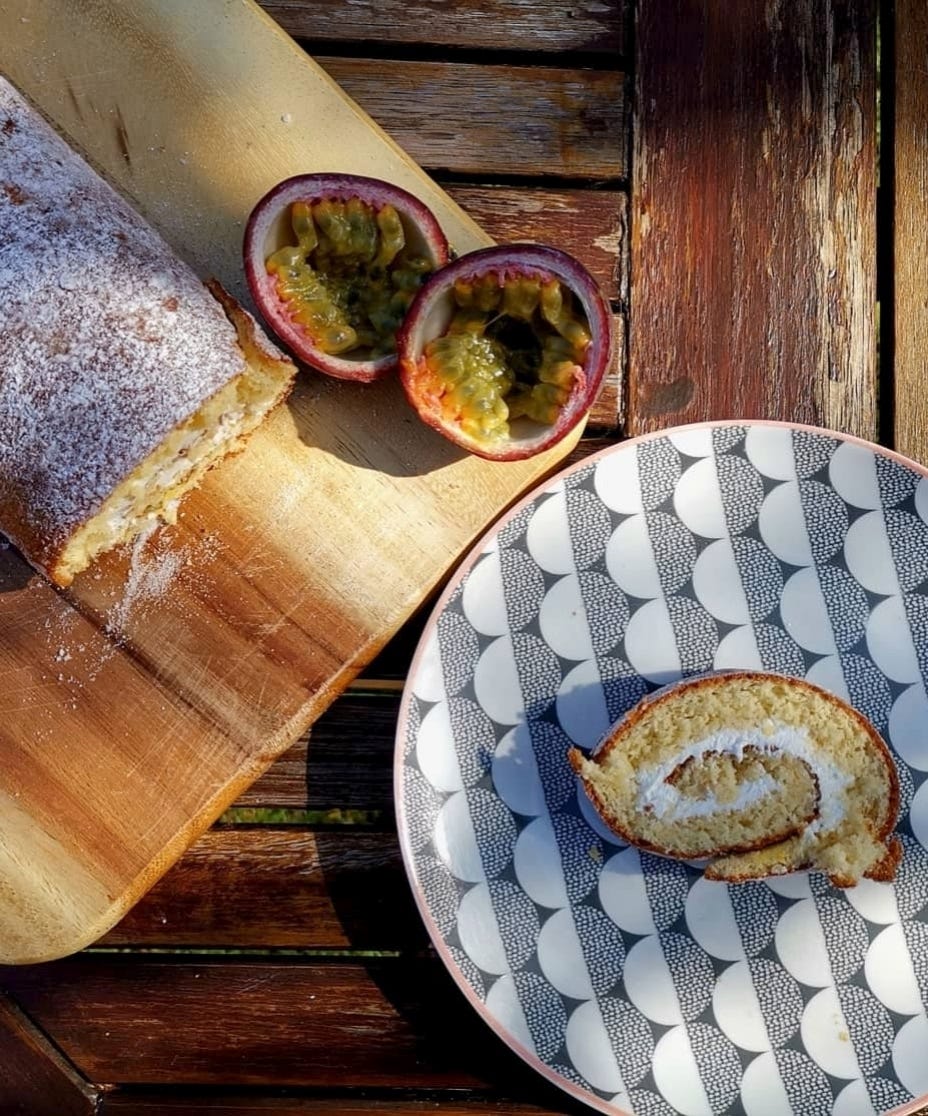
These days, it remains one of my favourite desserts when I wish to produce something that appears impressively elaborate without actually demanding heroic labour. A lemon-scented sponge filled with strained Greek yoghurt and sharp passionfruit pulp has become something of a personal signature, the contrast between sweetness and acidity a real treat.
Yet I also retain sentimental affection for a Black Forest roulade, particularly at Christmastime, wherein chocolate sponge is rolled around cherries and cream perfumed with kirsch and the whole thing is dusted with a blanket of cocoa.
It is a cake that deserves more love than it receives. On contemporary food social media, where towering layer cakes and glossy mirror glazes tend to dominate, the roulade sometimes appears faintly unfashionable. It may seem a little retro. A little old-school. Perhaps even a little naff.
To which I can only respond with a piece of advice.
If you wish to understand the roulade properly, indulge in a little Fanny Craddock.
FOODIE QUOTE OF THE DAY:
‘‘A party without cake is really just a meeting.’’
- Julia Child
Who are the cultural icons that have shaped your foodie self today?
Do you love a roulade? What are your favourite flavours? Do let me know!